Friday, January 27, 2023

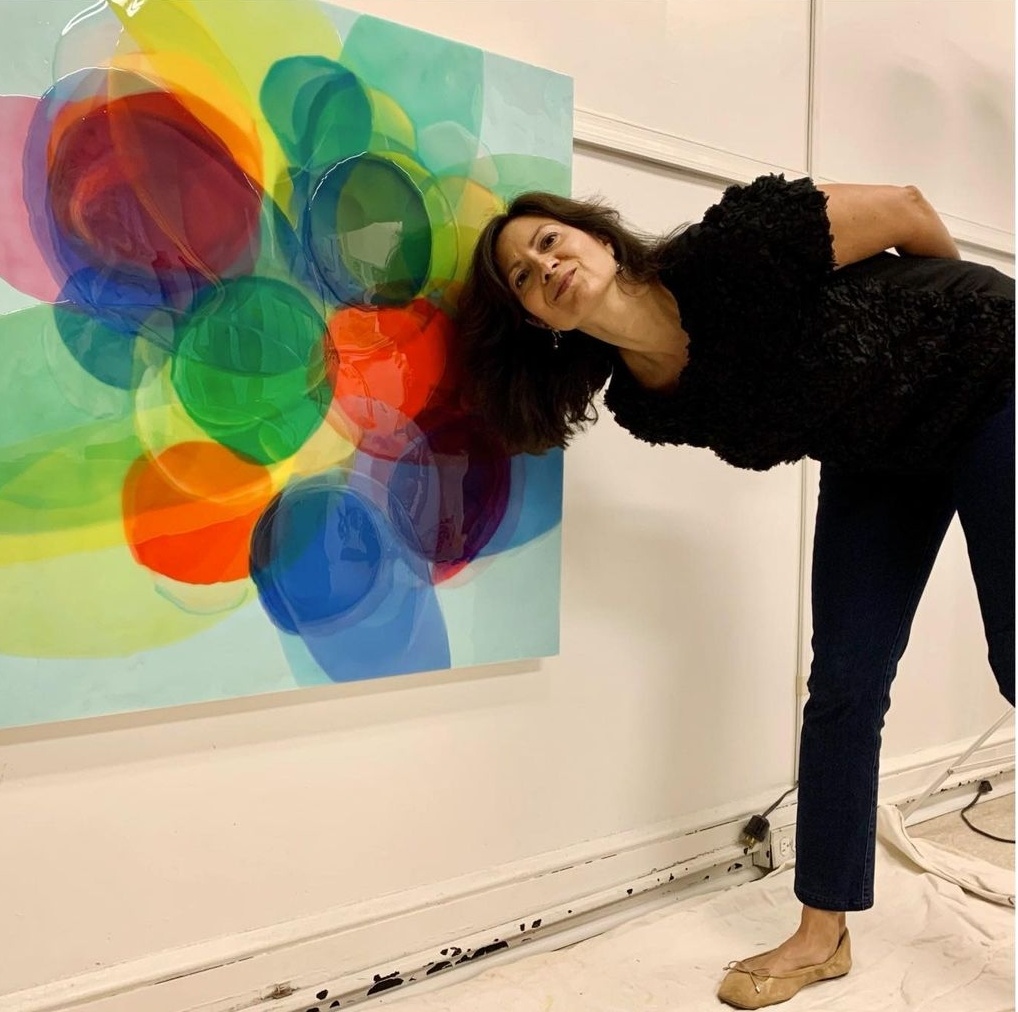
Maria Orozco, Artist


Hello and welcome to the 51st 3 Art Questions With Jackson interview! This time I interviewed Mexico based artist Maria Orozco. I discovered her art on Instagram and I love how unique it is and I especially like the clean lines and edges, and through this interview I discovered that we both admire Carmen Herrera. It is always interesting for me to interview artists from other countries to get a different perspective. I found Maria's answers super interesting and I think you will too! Thank you for reading! (Instagram: @mariaarte0 Website: www.mariaarte.com / All images courtesy of the artist)   


Jackson: Do you feel like you were born to be a visual artist? Or did you have an experience that made you want to be an artist?


Maria: I consider that when you are a child there is no total conception of the profession that you want to adopt when you grow up, however when you are a child you develop skills that lead you to what you like. In my case my father was an architect and he liked to paint, which caused my interest in painting since I was a child, thanks to my father my approach to the plastic arts and architecture was there since I was a child.


Jackson: I really like your style. Do you feel like your art is influenced by what you see around you or are there other factors?


Maria: Thanks! Everything is always influenced, nobody invents the black thread. In my pictorial exercise I retake the conformation of geometric compositions as a reference to the forms and conception of Constructivism and Brutalism, from its historical booms to the traces that in the present maintain the impact of its origins. Provoking an exercise of plastic interpretation of the forms, the space and the emptiness with which I compose on the canvases, forms that can be appreciated from the juxtaposition of elements and their sizes, to the detail of influences of Hard Edge painting. 

Painting is the constant means of my process to combine the conceptual and transversal interests of my professional knowledge and curiosity to find new ways of self-interpretation.     


Jackson: If you could meet any artist living or dead, who would it be and why?


Maria: I would love to meet several artists but if we are being specific this would be my top 5:

1. Inge Dick
2. Auguste Herbin
3. Theo van Doesburg
4. Carmen Herrera
5. Le Corbusier

I admire the work of each of them, I consider it super interesting how they projected themselves creatively in their respective times and countries.

Tuesday, January 17, 2023

Betsy Ruth Byers, Artist


Hello and welcome to the 50th 3 Art Questions With Jackson interview with Betsy Ruth Byers! 50! I have been to several of Betsy's exhibitions since I was 12 years old and I have always loved her use of color and how her paintings are a different type of abstract painting. As I expected, I loved her answers and I think you will too! Thank you for reading! (Instagram: @betsyruthbyers Website: www.betsyruthbyers.com / Images 1 and 4 courtesy of the artist)


Jackson: How did you end up on an artistic life path? Did you have a specific experience?


Betsy: When I was a kid I loved to draw and observe outside. My parents were both teachers, so I was lucky enough to have long stretches of time up up north at my grandma's cabin and farm...I spent many mornings on the dock trying to capture the linework of the waves. It never occurred to me to be an artist when I grew up. Looking back, I intuitively knew that drawing was a way for me to see better and therefore begin to understand the natural relationships spread out before me.

I went to a liberal arts undergrad institution because I enjoyed studying many things. I thought I might pursue medicine or architecture. I ended up taking oil painting for the first time my sophomore year and that was it! I fell in love with the process and the possibilities that it offered. I declared an art major with an environmental studies concentration. My path has weaved back and forth in the decades that followed, but my work continues to intersect with landscape, science and the power of observation and imagination. 


Jackson: I've noticed when encountering your work that nature plays a big part. Do you think that nature informs your painting or that your painting is about nature?


Betsy: I love this question. I would say both...I think from the beginning nature has informed my work. I grapple with questions such as: How does the landscape make us feel? How do I translate deep space? How can I capture the beauty of peripheral light reflecting off the water? The paintings usually begin inspired by multiple photographs I have taken on research trips. Somehow in the process of painting a transformation or flip takes place...the work does become about nature. Ultimately, I am working from a place of empathy for the natural world and I am hopeful that my viewers can feel this when they spend time with my work. 


Jackson: If you could meet any artist living living or dead, who would it be and why?


Betsy: There are so many! If I have to pick one today, I would say Claire Sherman. Her paintings are full of life and movement and capture both the visceral and quiet moments in the landscape. I admire how her brush strokes form planes that expand into larger forms. I would love to peak inside of her studio and see her process!

Wednesday, January 11, 2023

Farida Hughes, Artist


Hello and welcome to the 49th 33 Art Questions With Jackson interview! This time I interviewed the super impressive Farida Hughes, an artist I really admire and who enjoys using color in her work as much as I do. I had loved her Instagram and then became even more of a fan when I saw her work in a show at one of my favorite galleries - Catherine G Murphy Gallery. Her thoughts about art were very interesting to me and I am sure they will be to you too! Thank you for reading! (Instagram: @faridahughes_artist / Images 1, 3 and 4 courtesy of the artist) 


Jackson: What inspired your interest in making art? Are you from an artistic family? Did you have an experience that stayed with you?


Farida: There isn't one thing that I can identify that inspired my art-making. My father was a chemical engineer and would sometimes bring home technical drawings he made, but I didn't understand any of that aside from being impressed by the giant rolls of paper and blue lines. My mother came from a farming background and has a strong DIY attitude about everything. I am certain that influenced me early on. I was always "good at art" and I think I got that identity moniker among the kids in grade school. I would lose myself in art work. As a young girl on the many long car trips with family I would occupy myself by taking my fingers and framing little compositions of shapes, lines, and colors as I saw things go by out the window. I told this memory to a friend when I was in graduate school and she said "You were born to be an artist!" Doodling and dreaming are pleasant activities easily accomplished, but the desire to arrange in place all the necessary things to bring something of visual communication into the world, (time, space, energy, tools, and supplies), that is a different kind of drive and passion. Probably seeing people around me build and make things helped influence me on this path.


Jackson: I love your use of color and I respond to it because I also love using color. How did you settle on the use of bright colors in your work? What does it mean to you personally?


Farida: Color is everything. I embrace color; to me it is the driving force in my work. Color choice don't always inform my composition, but once I choose a color to begin with it definitely informs the composition to the end. I use color both metaphorically and allegorically, letting it stand in for social or political ideas I might want to express. Exploring both the visual and the physical weight of color is a back and forth process in painting, like a little dance, that is so engaging but sometimes also infuriating. People often ask me, especially with my Blends project, if I assign a color to a meaning, like a label, but I work hard to stay away from that. Color is infinitely variable, like humanity, so that, to me, is poetically important. The choices and combinations are endless. For a time I really disliked primary colors because they were so absolute, and intentionally chose a palette based on the secondary, tertiary, and the "grays" of intermixing, but I have explored in primaries in recent years years and found that I can like them when I edge them toward difference. I do think my practice of incorporating my colors into resin makes them brighter, more intense. This vibrancy makes them seem more colorful, however, I am using the exact same paints I use when I paint with oils on canvas. There is something about the way light passes through the medium that affects how we experience the color. All of this makes painting so exciting!


Jackson: If you could meet any artist living or dead, who would it be and why?


Farida: Today, I would have to say I would love to meet the living artist Amy Sillman. She is an extraordinary painter, but also a critic, a writer, and a teacher. She seems to know everybody, or at least their art. She has something to say about everything, and does so articulately and with wit and intelligence most don't match. She doesn't take herself too seriously, and approaches both life and the work in the studio with a sense of humor that makes this task of "being an artist" all the more human. I would love to hang out with her in front of a huge Gerhard Richter abstract painting and geek out about paint, Darth Vader, the sides of barns, or whatever else came to mind, and savor the bits of wisdom that those random mental exercises inevitably reveal. 

Thursday, December 22, 2022

Dao Strom, Artist


Hello and welcome to the 48th 3 Art Questions With Jackson interview! This time I interviewed the fascinating and multi-talented Dao Strom. Her show at Catherine G. Murphy Gallery really stuck with me and I am so pleased that she agreed to do this. Her answers provide a lot of insight into her work and process and I think you will enjoy them. Thank you for reading! (All images courtesy of the artist / Instagram: @herandthesea)


Jackson: What first inspired you to be an artist? Were you motivated by a specific experience?


Dao: There is no specific experience that awoke me to the role of art in my life - creativity has always been a huge part of my being ever since I was a child. Perhaps it helped that I had a mother who was a writer and so I was encouraged by her - to a degree - to write and draw when I was young. Writing, language, stories, the imagination were natural refuges for me, and I wrote stories and drew pictures and made up worlds in my head all through my youth. But instead of studying writing when I went to college, I decided to study filmmaking; this is where the use of the camera and visual techniques first became a more intentional field for me, perhaps. As for music, I had no notions of myself as a musician until I began exploring music in my early twenties. I would say the music came to me - a box of cassettes (back when this was the listening format, yes) of traditional folk musicians found on a sidewalk in New York City one afternoon, played a part in opening a door onto a genre of music that led to me wanting to learn how to sing and play guitar myself. My journey toward and through those mediums of "voice" I inhabit has felt, for me, like a very organic, winding path. 


Jackson: I really like your poetry and music but I particularly love your video art. Do you have a preference? Are the video pieces more difficult to realize?


Dao: I have individual relationships with all of these mediums, and yet, and also, I feel that it is important for me to recognize how the hybrid space/forms where these three voices come together is itself unique and where the endeavor of my art finds its biggest tensions. At least for myself the melding of mediums is maybe also a re-pairing - an urge to reconnect - disparate, fragmented spheres of myself. I think it is the same 'voice' that manifests through each medium, that is not content to just sound through one format or conduit alone. That all can carry through without relying on a body, on concrete materials, etc, to be an experience - the way a song can be sung/played by anyone who cares to inhabit it; a song is such an amorphous, wondrous vessel. As for the video pieces: since the imagery often involves myself playing a part or performing some action, I have collaborated with others behind the camera, and also in the editing process at times. My collaborators, however, have (so far) been only a couple people who are quite close to me - friends, loved ones. Some of the video work also involves found imagery, whether personal or documentary. The video-making process, although physical and involving collaboration, is still quite intimate and interior, I don't go into it with planned ideas for what to shoot, for instance, but more just a few rough ideas, then we go looking for the right settings and objects, and see what unfolds. A lot is created later in the editing process.  


Jackson: If you could meet any artist living or dead, who would it be and why?


Dao: Theresa Hak Kyung Cha - but maybe only to witness a performance by her or hear her voice, embodied. I would not myself know what to say to her and would be happy to just hear/allow her work to speak for itself.

Saturday, October 8, 2022

Sarah Kusa, Artist


Hello and welcome to the 47th 3 Art Questions With Jackson interview! This time I interviewed the super talented and unique Sarah Kusa. I have been following what she does for many years and I always take something new from her art whenever I see one of her shows. It always leads to a discussion which I think is a real achievement. Her answers were really great and I think you will agree! Thanks for reading and try to catch Sarah's show at Catherine G. Murphy Gallery! (Artist photo by Rebecca Slater / Other photos from the Instagram I run with my Dad: @artworldexploration / Artist Instagram: @ kusasa / Artist website: www.sarahkusa.com) 


Jackson: What inspired you to become an artist? Was it early in life?


Sarah: As a kid I was constantly creating: drawings, elaborate habitats for stuffed animals, outdoor forts, and clothing. I grew up seeing my father use tools to make things, and our home was full of my grandmother's quilts and embroidery work, so I was keenly aware of what was possible to make by hand. At my first elementary school, my art teacher would borrow taxidermy mounts from the university museums for us to observe and draw. Art hooked me early on.

In high school I took art classes, but I chose not to go to art school for a variety of reasons. I studied journalism and mass communication in college instead and went to work in advertising. A few years in, I took a screen printing class at Highpoint Center for Printmaking in Minneapolis. After years of working exclusively with the computer, it was my gateway back into hands-on artwork. I knew I needed a career shift and started a small business printing fabric and making decor goods for the home. Over time I was more invested in creating than in selling mass quantities of product, so I let the business fade and followed my curiosity into art. That was when I started going down the deep, dark rabbit hole of sculpture and installation. I have always been interested in physical spaces, so I think that is why I gravitated to 3D. I never really set out to be a professional artist, but somewhere along the way I decided to follow my art for as long as I could sustain it. There are definitely easier career paths, but like many artists, I am one of those people who continue to pursue art because it meets one of my most basic needs.  


Jackson: Do you consider your art sculptural or conceptual? Both? What type of response do you hope for?  


Sarah: I work in 3D for the most part, but not exclusively. Sometimes my work is more sculptural in nature, and sometimes it is more like three-dimensional drawing, when the process is fairly immediate and gestural. Early on my work was often about making an object either to see what it felt like to make or what it did in space. Now there is almost always a set of questions I am working with when I start new work in the studio. I'm often thinking about some aspect of human vulnerability or how a particular material mirrors the body. I typically have something in mind from my own life experience, but I'm unlikely to share specifics because I want the finished work to be broader than me. I try to present my art in a way that is open enough for others to have their own sensory experience and make connections to their own lives. My hope is for people to come away from my work with a fresh perspective, a sense of shared humanity, and/or a sense of empathy for others. 


Jackson: If you could meet any artist living or dead, who would it be and why?


Sarah: This is a surprisingly tough question. If I could choose two (I realize I'm cheating), it would be Louise Bourgeois (who died in 2010) and Ursula Von Rydingsvard (who is 80 years old and still at work). Bourgeois was not one of the first artists I was drawn to, but the longer I have been an artist, the more I come back to the breadth and emotional power of her work. Von Rydingsvard is a contemporary sculptor making amazing large-scale work from wood and metal. If you can track down the recent documentary about her called Into Her Own, it is so good. Both artists are powerful examples of female sculptors with long careers that I deeply admire.


Wednesday, August 17, 2022

Joshua McGarvey, Artist


Hello and welcome to the 46th 3 Art Questions With Jackson interview! This time I interviewed Joshua McGarvey, an artist I've admired for a long time who is receiving a lot of well deserved attention. Joshua does very unique things with installation art, sculpture, and video art and has a current show at the Minneapolis Institute of Art that everyone should go see. As I expected, his answers were very interesting and informative. I think you will agree! Thank you for reading! (Instagram: @joshuadmcgarvey, website: joshuamcgarvey.com, all images courtesy of the artist)


Jackson: What inspired you to be an artist, and a video artist in particular? How old were you when you settled on the idea?


Joshua: My mom was always very creative. She drew and would occupy me and my brother often with pencil and paper. My interest in being an artist grew from there. I was always drawing. In school, I was often called by teachers for "doodling" too much. Then in college, I discovered printmaking (specifically intaglio, woodcut, bookmaking). Then in grad school, I discovered installation. Installation led to building sets and wanting to activate them with performance. Performance led to documentation. Documentation led to video. But also the works of artists like Kenneth Anger, Jack Smith, Peter Kubelka, Paul McCarthy, Bruce Nauman, David Hammons, Mike Kelley, Hito Steyerl, and Alex Da Corte led me towards video. I am also inspired by internet video culture and some reality TV. Although some of my more recent large scale pieces have been focused on video, I consider myself a multidisciplinary artist working with but not limited to performance, sound, interactive elements, and materials such as textiles, scuplture, photography and video. My current exhibition "POSTURING" at Minneapolis Institute of Art's MAEP Gallery includes some large sculptural works that play off the videos in a way that expands the concepts of the installation from hyper personal to institutional critique. 


Jackson: When did you begin using masks in your art and why? Does it relate to the humor and irony you use or do you see it as separate?


Joshua: I printed the masks of my own face in 2017 as I was developing my work for the Jerome Fellowship for Emerging Artists exhibition at MCAD (The Program, 2018). The mask was born of the question, "how do I remove myself from my video performances of hyper personal ideas." I began trying to cast a new me, and my work utilizing the mask grew, abstracted, and evolved from there. In my video "An Interview with the Artist Joshua McGarvey" the mask represents a concept I call "emotional anonymity", which explores digital identity, privacy, futility, and presentations of self by using the mask to hide my facial expressions during an interview. In terms of humor/irony, I try to use that as a disarming quality in my work, like a mechanism to casually engage my audience while exploring abstract concepts.  


Jackson: If you could meet any artist living or dead, who would it be and why?


Joshua: I would like to hang out with Mark Manders. I love his work. I really admire his ability to intertwine language and sculptural forms. His piece "Shadow Study (2)" is so beautiful, haunting, simple, and poetic. The way his text allows you to enter the sculpture is very satisfying to me.

http://www.markmanders.org/works-a/shadow-study-2/2/

Tuesday, August 9, 2022

Rima Chahine, Artist


Hello and welcome to the 45th 3 Art Questions With Jackson interview! This time I interviewed United Arab Emirates based painter Rima Chahine. I love her style of painting and her approach to making art. She has been kind enough to check out what I've been up to with my art which I always appreciate. I think her advice about believing you can do it even when others tell you you can't is great. Thank you for reading! (Instagram: rimachahine.art, website: rimachahine.com, all images courtesy of the artist)


Jackson: On your website you say you believed in yourself when no one else did. Did that make you more determined to be a successful artist or impact the type of work you make?


Rima: I always felt growing up that many things did not resonate with my being in the culture I grew up in. The state of being of people I met along the way made me feel like an outcast often, so this is what made me become an artist. I believe in free expression, I applaud high sensitivity in life and in art, in being true to who you are no matter the costs. This is my art expression. It is peace, love and authenticity. 


Jackson: Did the pandemic affect your career or change the way you made your paintings? I lost some opportunities and noticed I was using brighter colors.


Rima: Yes, it did. I needed to do more travelling, attending international art fairs and exhibitions to find bigger opportunities for exposure and sales.


Jackson: If you could meet any artist living or dead, who would it be and why?


Rima: Monet. I like his art gentleness. So expressive and soft. I wish to paint with him one day.